

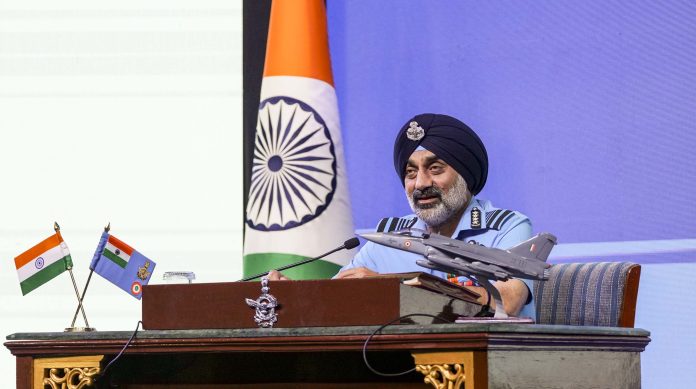
Indian Air Force (IAF) Chief, Air Chief Marshal Amar Preet Singh, confirmed on Friday that the IAF successfully destroyed 4 to 5 Pakistani fighter jets, primarily F-16s, during a strategic mission known as Operation Sindoor.
Speaking to the media in New Delhi, Singh detailed the high-stakes operation, where the IAF executed precision strikes on various Pakistani airbases, resulting in significant destruction of radars, command centers, runways, and hangars. Additionally, he noted that a C-130-class transport aircraft and a high-value surveillance plane were also targeted and likely damaged.
“We struck a myriad of their airfields and military installations. The results include the obliteration of radars at four locations, command centers at two, two runways, and three hangars. We have concrete evidence showing one C-130 aircraft was affected and that 4–5 fighters were under maintenance during the strike,” stated Air Chief Marshal Singh.
Furthermore, Singh highlighted that during Operation Sindoor, the IAF leveraged its newly acquired long-range surface-to-air missiles (SAMs). This pivotal technology prevented the Pakistan Air Force from executing operations effectively, even within their own airspace. The operation also marked a landmark achievement, recording the longest missile strike of over 300 kilometers, thereby crippling Pakistan’s aerial response capabilities.
Labeling the operation a decisive and time-bound success, Singh remarked, “The mission commenced with a clear objective and wrapped up promptly upon achieving our goals. In contrast to prolonged global conflicts, India illustrated how clarity and precision can compel an adversary to seek a ceasefire.”
Singh’s comments carry weight beyond this operation, as he asserted that the lessons learned should resonate globally. “This experience serves as a teaching moment for the entire world, especially during times when international conflicts show no sign of resolution,” he added.