

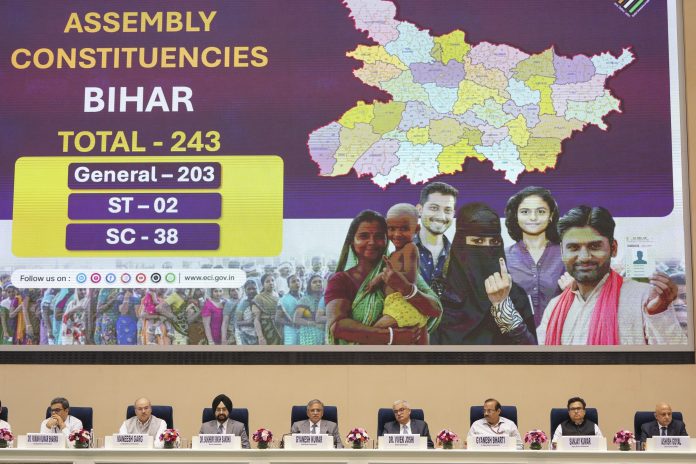
Chief Election Commissioner Gyanesh Kumar officially announced on Monday that the Bihar Assembly elections will occur in two phases: on November 6 and November 11. The counting of votes will take place on November 14, completing the electoral process by November 16. This significant announcement marks a crucial event in Bihar’s political landscape as the state prepares for its next legislative assembly.
During the press conference, Kumar dubbed the upcoming Bihar polls the “mother of all elections”, highlighting its importance for democracy in the region. He stressed the need for transparency and efficiency throughout the electoral process, which will involve 243 Assembly constituencies across the state.
According to the Election Commission’s schedule, the first phase will see elections in 121 Assembly constituencies on November 6, followed by 122 constituencies on November 11 in the second phase. This staggered approach aims to facilitate better management and security during the high-stakes election period.
“It is mandatory to complete counting of postal ballots before the last two rounds of counting of votes,” emphasized Gyanesh Kumar during the announcement. His statement underscores the importance of timely and accurate vote counting, especially in light of the rising significance of postal ballots in recent electoral trends.
The timeline for nominations and withdrawals also plays a critical role in this electoral process. For the first phase, the last date for filing nominations is set for October 17, followed by scrutiny on October 18. Candidates will have until October 20 to withdraw their nominations. In the second phase, the timelines are similar; nominations will close on October 20, with scrutiny occurring the next day. Candidates can withdraw their nominations until October 23.
The current term of the Bihar Legislative Assembly is set to end on November 22. This timeline creates an urgency for political parties and candidates, as they prepare strategies and campaigns to secure their positions ahead of the impending elections.
Bihar’s electorate consists of diverse socioeconomic groups, often making this election pivotal in shaping local governance and development. The significant number of 38 reserved constituencies for Scheduled Castes (SC) and two reserved for Scheduled Tribes (ST) ensures representation across various communities in the assembly.
As the election dates approach, political campaigning is expected to intensify, with parties focusing on key issues such as development, employment, and social justice. Voters will be keenly watching how candidates address these concerns and rally support to emerge victorious on polling days.
The announcement of the Bihar Assembly elections by CEC Gyanesh Kumar sets the stage for an engaging electoral battle, resonating not only within the state but also across the political spectrum of India. With the countdown now underway, Bihar prepares for what promises to be a crucial election season.