

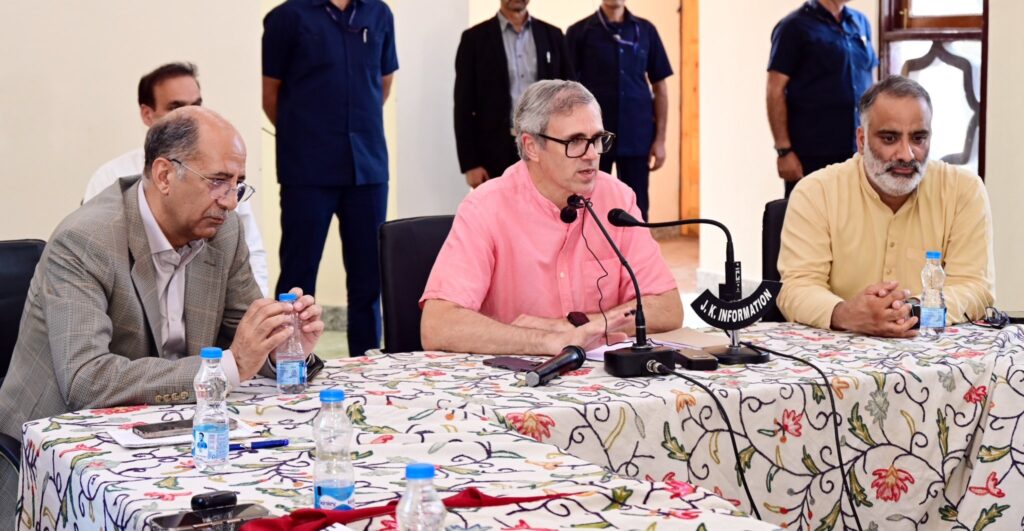
Chief Minister Omar Abdullah on Tuesday said that the agriculture sector in Jammu and Kashmir holds vast untapped potential, and emphasized the need for focused attention on value addition to fully unlock business opportunities across both regions of the Union Territory.
The Chief Minister was addressing the National Executive Committee Meeting of the Federation of Indian Chambers of Commerce and Industry (FICCI), held in Srinagar. The meeting was attended by FICCI President Harsh Vardhan Agarwal, Senior Vice President Anant Goenka, Director General Jyoti Vij, Past President Dr. Jyotsna Suri, Chairman FICCI J&K Council Mushtaq A. Burza, and other members of the National Executive Council.
Highlighting the need for industrial diversification, Omar Abdullah said that most of Jammu and Kashmir’s produce leaves the region in raw form, with minimal local processing or value addition.
“This opens significant opportunities for industrial growth — both on Jammu’s side and in the Kashmir Valley,” the Chief Minister stated.
He cited the dairy sector as a prime example, revealing that only 4–5 percent of J&K’s dairy output is processed within the Union Territory, while the remaining bulk goes unprocessed into markets outside. He urged industry leaders to explore investments in food processing, packaging, and allied sectors.
Referring to recent challenges, Omar Abdullah said that J&K’s economy has faced setbacks due to natural calamities and a tourism slowdown following the Pahalgam incident, but the administration remains “optimistic and resilient.”
“This is not a story of pessimism but of hope and optimism. We are working hard with all stakeholders to put the economy back on track,” he said.
The Chief Minister also said that the government is actively engaging with domestic and international tourism partners to attract visitors and revive Jammu and Kashmir’s tourism sector, calling the region “the country’s premier destination.”
Omar Abdullah further outlined key growth areas for sustainable and competitive industrial development, including agriculture, horticulture, handicrafts, electronics, pharmaceuticals, packaging, and cement. He said that upcoming infrastructure projects such as the Delhi–Amritsar–Katra Expressway and the four-laning of the Jammu–Srinagar National Highway will strengthen logistics and boost investment opportunities.
Reaffirming the government’s focus on improving the ease of doing business, he invited FICCI’s feedback on policy reforms to make Jammu and Kashmir a more investor-friendly destination.
“We are keen to learn from best practices across the country. Reforms will be guided by feedback from the industry itself,” Omar said.
He also called upon the corporate sector to extend Corporate Social Responsibility (CSR) support in youth-centric areas such as sports, libraries, and skill development. He urged companies to collaborate with the government in upgrading ITIs and skill centres to create an employable workforce.
Concluding his address, Omar Abdullah reaffirmed the strong partnership between Jammu and Kashmir and FICCI, expressing confidence that continued engagement will yield tangible results.
“This is a long-standing relationship, and today’s meeting marks another step towards strengthening cooperation and building new opportunities for the people of Jammu and Kashmir,” he said.