

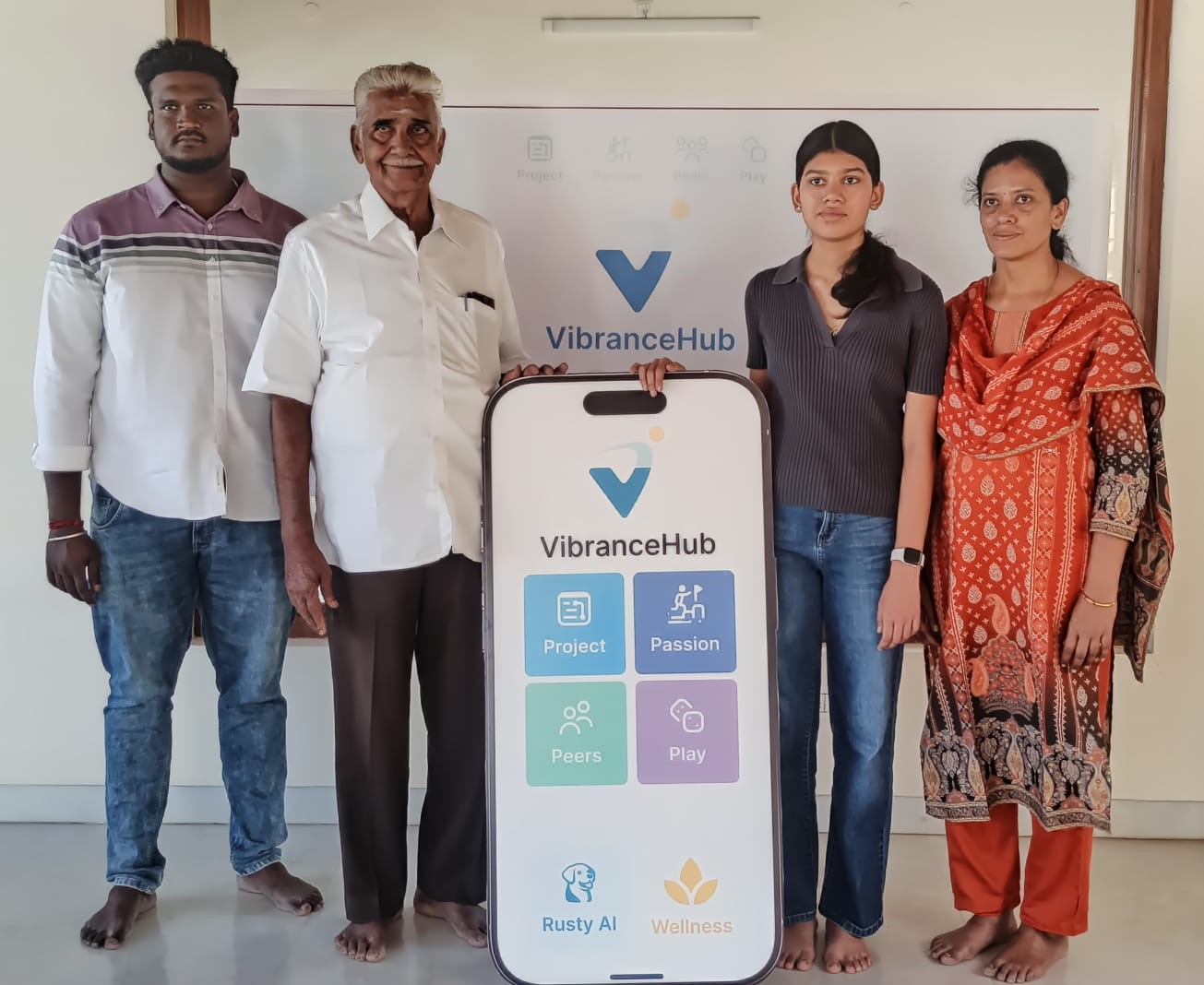
COIMBATORE — Rithanya Sivaram, a Class 12 student at The Indian Public School, has launched Vibrance Hub, a pioneering platform designed to integrate project-based learning, peer collaboration, and wellbeing support. This initiative comes at a crucial time as India shifts towards preparing students for a future dominated by artificial intelligence (AI), where creativity and continuous innovation increasingly outweigh rote memorization.
“In the age of AI, information is commoditized. What matters now is what you can make, how you think, and whether you can sustain creative work over time,” Sivaram stated. She emphasized that while Atal Tinkering Labs provide crucial resources for students to tinker and innovate at a national level, Vibrance Hub offers the necessary scaffolding, community support, and wellbeing practices to help transform interests into ongoing creative projects.
Drawing inspiration from MIT’s Lifelong Kindergarten framework comprising Passion, Projects, Peers, and Play, Vibrance Hub recognizes that maker education transcends mere construction. It focuses on nurturing skills like computational thinking, iterative resilience, and teamwork—attributes that remain beyond the reach of AI.
“Atal Tinkering Labs have given students the tools and space to tinker at a national scale. Vibrance Hub gives them the scaffolding, community, and wellbeing practices to turn interest into sustained making,” Sivaram reiterated, underscoring the holistic approach her initiative aims to adopt.
Interestingly, Vibrance Hub echoes India’s historic educational traditions. Before the British colonial era imposed a rote-learning approach through Macaulay’s Minute on Education in 1835, India’s gurukul system emphasized experiential learning. Students actively engaged with subjects—be it metallurgy through forging, astronomy through observation, or medicine through practice—learning by creating rather than passively consuming information.
The National Education Policy (NEP) 2020 actively supports this return to a maker-centric educational model, identifying the need to foster creativity and innovation in India’s future workforce. It posits that India’s prosperity hinges on cultivating creators instead of mere information processors.
The Atal Innovation Mission (AIM), initiated by NITI Aayog in 2016, stands as India’s most ambitious attempt to implement this maker-centric philosophy at a national scale. AIM directly addresses the NEP 2020’s call for nurturing creativity and innovation by creating robust infrastructure for hands-on learning across the country. Vibrance Hub aligns with AIM’s vision, aiming to forge new paths in the educational landscape while fostering well-rounded developmental practices in young learners.
By integrating wellbeing through yoga into project-based learning, Vibrance Hub addresses both the mental and physical aspects of student development. Sivaram’s insight reveals a growing recognition of the importance of emotional resilience and wellbeing among learners in today’s demanding educational environment.
As educational reforms gain momentum, initiatives like Vibrance Hub will likely play a vital role in shaping a generation of innovative thinkers prepared to tackle the challenges of the AI era.