

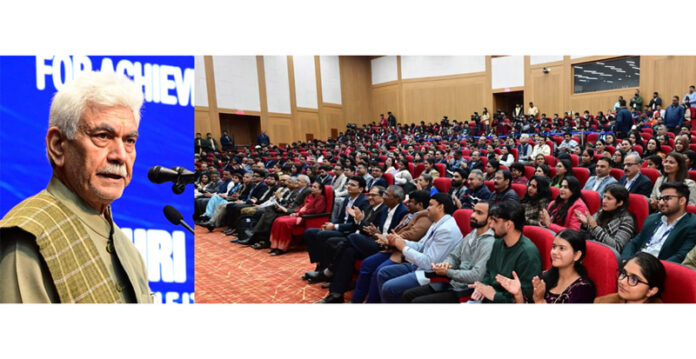
Lieutenant Governor Manoj Sinha announced that significant portions of India have achieved a state of being terrorism-free. This statement came during the three-day Strategic Management Forum (SMF) Conference held at the Indian Institute of Management (IIM) in Jammu. Sinha highlighted that except for a few isolated areas, most of the northeastern states have also experienced a decrease in violence. Furthermore, he noted a sharp decline in local recruitment to terrorist groups in Jammu and Kashmir.
During his address on Monday, Sinha asserted, “Large parts of the country have been freed from terrorism. Most of the northeastern regions are now quiet. The threat from left-wing extremism and Naxalism, which previously posed a considerable risk, now remains contained largely to just two or three districts.” This marked shift signifies a considerable improvement in national security.
In discussing the situation in Jammu and Kashmir, Sinha stated there are no longer any top commanders of terrorist groups alive in the region. He emphasized the dramatic decline in local recruitment, claiming, “Hardly one or two youths are being recruited now.” This reduction, he believes, is a positive step toward lasting peace.
Despite the decline in local recruitment, Sinha attributed ongoing security concerns to Pakistan’s attempts to infiltrate terrorists across the border. He remarked, “Those coming from across the border are hiding in dense forests and hilly areas. I assure you they will be eliminated. Regardless of the time it takes, they will not survive.” His statements underline the continued vigilance required to combat cross-border terrorism.
Furthermore, Sinha highlighted a shift in the profile of individuals drawn into terrorism, stating that educated and informed young people seem increasingly engaged. He insisted that combating terrorism would require collaborative efforts from not only security forces but also local society and various administrative branches. “The fight against terrorism cannot depend solely on security forces in areas like Jammu and Kashmir, or parts of Karnataka and Kerala,” he noted.
Sinha also urged for an end to the divisive “insider-outsider” narrative prevalent in public discourse, stating it obstructs progress and unity in development efforts. This call to action seeks to foster a cooperative environment crucial for societal growth.
On India’s developmental goals, Sinha expressed that leaders from policy-making circles and business sectors would play an essential role in charting a course for achieving Viksit Bharat by 2047. He said, “Our focus should be on macroeconomic stability, significant investments in education and health, digital advancements, good governance, transparency, accountability, and speedy project execution.” His ambition reflects the overarching goals of the Indian government under Prime Minister Narendra Modi.
Sinha showcased India’s economic growth and said that the current momentum under Modi’s leadership is unprecedented. He cited increasing confidence among industry leaders and noted that various sectors—from manufacturing to handloom—are now competing on a global scale, propelled by a national push for Swadeshi.
He then shifted the focus to Jammu and Kashmir, emphasizing the region’s untapped potential in mining. Sinha stated, “Jammu and Kashmir possess vast reserves of limestone, sapphire, and lithium, among other minerals. Through strategic planning, we could generate an additional annual revenue of Rs 15,000 crore to Rs 20,000 crore in the next five to seven years.” This reveals a vision for harnessing the region’s natural resources to bolster economic growth.
Highlighting the importance of the hydropower sector, he recommended revisions to the Holistic Agriculture Development Programme (HADP) to adapt to changing economic demands. This measure aims to leverage the state’s unique resources for wider benefit.
Additionally, Sinha inaugurated the Basohli Painting Exhibition and presided over the closing ceremony of the Basohli Painting Workshop. He commended the artists involved, stating, “Basohli Painting is our invaluable cultural legacy that holds significant worth for future generations.” This initiative reflects the government’s commitment to preserving and promoting cultural heritage.
Prominent figures in attendance included Prof B.S. Sahay, Director of IIM Jammu; R.K. Chaudhary, Chairman of JERC J&K and Ladakh; and Subash Chandra Meena, Economic Advisor at NITI Aayog, among other academicians, policymakers, artists, and students.