

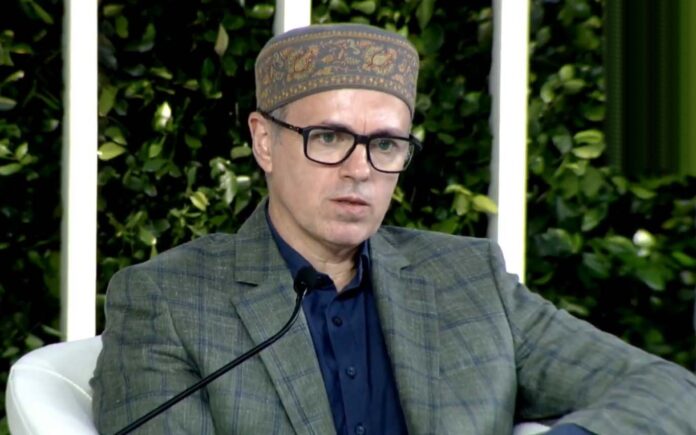
Jammu and Kashmir Chief Minister Omar Abdullah recently articulated a significant concern regarding his role as the leader of a Union Territory (UT). Abdullah described his position as one of “disempowerment” and highlighted his unique misfortune of evolving from the head of an empowered state to leading a UT with diminished powers. This statement came during an event organized by a national newspaper on Wednesday in Jammu.
Abdullah expressed his dissatisfaction with the current administrative structure, asserting that he faces an unusual challenge as he adjusts to the limited authority that comes with the UT designation. He pointed out frequent interferences by the Lieutenant Governor’s office, calling for a clearly defined timeline for the restoration of statehood in Jammu and Kashmir.
“I hate being reminded that we are a Union Territory,” Abdullah stated. He reminisced about his earlier tenure when the term “State” carried weight among officers—a stark contrast to the current emphasis on UT status.
Power Struggle with LG Office
While addressing the allocation of power, Abdullah characterized the situation as “asymmetrical.” He claimed that Lieutenant Governor Manoj Sinha holds responsibilities traditionally reserved for an elected government. Specifically, he criticized Sinha’s involvement in chairing meetings related to the Jammu and Kashmir Power Development Corporation and convening tourism meetings—tasks Abdullah believes should not be managed by security-focused governance.
“What business does someone responsible for security have holding a tourism meeting?” he questioned, showcasing his concerns about governance effectiveness.
The Chief Minister also highlighted that several cabinet decisions remain stalled at the Lieutenant Governor’s office, including critical changes to reservation percentages. “There is an asymmetrical allocation of power between the elected and unelected government,” Abdullah stated, reinforcing his call for restoring electoral accountability.
Statehood and Article 370
On the issue of stalled statehood restoration, Abdullah reminded the audience of the Centre’s three-step plan comprising delimitation, elections, and the restoration of statehood. “Two steps are complete. Why are we made to wait for the third?” he asked, asserting the necessity for a clearer dialogue regarding the expected timeline for statehood.
Challenging the Centre’s concept of an “appropriate time,” he urged the government to establish definitive goals rather than vague assurances. Abdullah emphasized that any delay in this process could mislead the public about the political climate in Jammu and Kashmir.
Regarding Article 370, which previously granted special status to Jammu and Kashmir, he indicated that any restoration would only be feasible with a change in the central government. “It is pointless asking the people who took it away from us to give it back,” he declared, stressing his dedication to the issue, while warning against making unrealistic promises.
Radicalisation and Governance
Abdullah also raised alarms about rising radicalisation within Jammu and Kashmir, correlating it with policies of hyper-nationalism and collective punishment. He condemned the demolition of houses belonging to families of terror suspects, calling these actions misguided and ineffective. “If those people are radicalised, whose fault is it?” he asked, reflecting on the consequences of punitive measures.
This discussion also touched upon recent issues related to sports teams and medical college admissions, which faced scrutiny due to a perceived inequity against selected Muslim candidates. “When you push an entire community to the margins, how can you expect no reaction?” he questioned, addressing the need for inclusive governance.
National Politics and EVM Debate
In terms of national politics, Abdullah described the opposition INDIA bloc as being in critical condition and not addressing Article 370 actively. He defended Congress leader Rahul Gandhi’s silence on the subject, asserting that Gandhi should first focus on winning elections before engaging in discussions about the contentious issue.
Breaking from his father, Farooq Abdullah, Omar expressed his belief against the tampering of Electronic Voting Machines (EVMs), choosing instead to acknowledge electoral losses as a matter of accountability, citing constituency delimitation as a significant factor affecting electoral outcomes.
Economy, Environment and Tourism
On the economic landscape, Abdullah addressed several pressing environmental concerns, mentioning pollution and dry spells in Srinagar, which he attributed to the valley’s geographic conditions trapping smog. He further clarified misconceptions about tourism being the sole economic driver for Jammu and Kashmir, stating tourism ranks fourth in contribution to the Gross State Domestic Product, trailing behind agriculture, horticulture, and industry.