

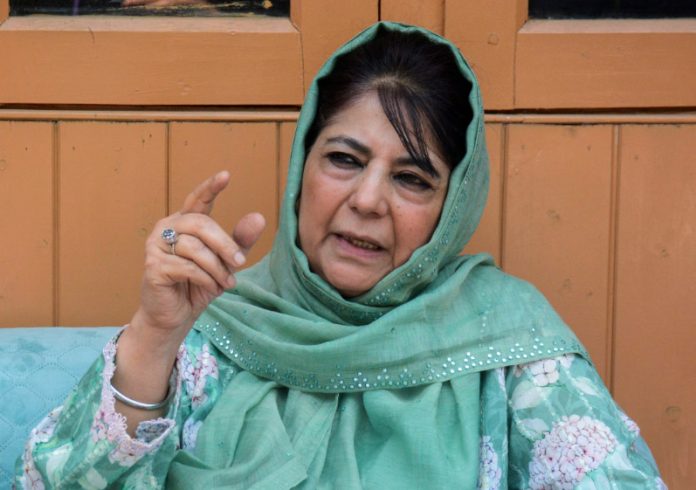
SRINAGAR, May 6: PDP president Mehbooba Mufti lambasted the ruling National Conference (NC) for attempting to distract the public from its failures by politicizing religious scriptures. Mufti’s remarks came during a press conference where she addressed recent allegations from NC spokesmen.
Seeking clarification on the political maneuvering, Mufti said, “For God’s sake, do not drag Quran into politics. They (NC) are doing this to hide their failures over the past two years of being in government. People are disheartened with them.” The former chief minister pointed out the public disillusionment with the NC’s performance.
Mufti’s comments followed a demand made by NC chief spokesman Tanvir Sadiq and MLA Zadibal, who insisted that she and her MLAs swear by the Quran that they did not vote for the BJP in last year’s Rajya Sabha polls in Jammu and Kashmir. This demand sparked controversy and intensified the ongoing political rivalry.
An RTI reply revealed that the PDP did not appoint a chief agent for the Rajya Sabha elections held in October last year, leading to NC’s allegations that three of PDP’s MLAs may have voted in favor of the BJP. Mufti dismissed these accusations, emphasizing that the ruling party should focus on its governance rather than resorting to slander.
Highlighting the pressing issues under the current administration, Mehbooba Mufti stated, “Houses are being demolished under the garb of fighting drugs. Earlier the same thing was done under the pretext of fighting terrorism. Employees are being summarily dismissed while open merit students are going through tormenting times.”
She criticized the government’s inaction, referring to it as a “mute spectator” to the problems faced by the people of Jammu and Kashmir. The former chief minister’s remarks aim to spotlight the governance challenges that persist in the region and urge a return to serious political discourse.
Mufti concluded her remarks by expressing her willingness to engage in political debate but urged the National Conference to refrain from using religious texts as tools of political game. This approach could lead to greater frustration among voters who are looking for solutions, not divisive tactics.