

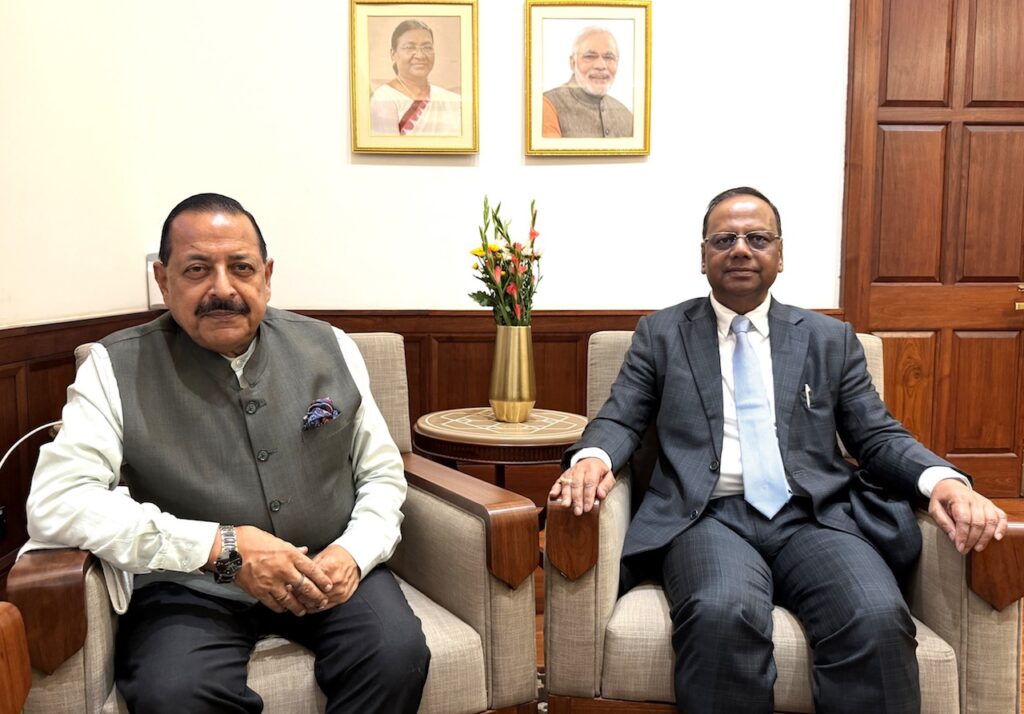
Justice Ranjit Vasantrao More, Chairman of the Central Administrative Tribunal (CAT), recently briefed Union Minister of State Dr. Jitendra Singh about the Tribunal’s reforms aimed at enhancing administrative justice. The meeting showcased the Tribunal’s significant achievements and its commitment to improving service delivery.
Since its inception, the CAT has dealt with over ten lakh cases, successfully disposing of more than 9.32 lakh cases, thus securing a remarkable overall disposal rate exceeding 93 percent. This statistic not only reflects the operational efficiency of the Tribunal but also underscores its commitment to upholding justice for government employees.
Dr. Jitendra Singh emphasized that the Central Government, under Prime Minister Narendra Modi’s leadership, prioritizes transparency, efficiency, and citizen-centric governance. He remarked, “Administrative justice is vital for good governance, and reforms must enhance accessibility for government employees nationwide.” Such sentiments resonate with the ongoing changes happening across various public institutions in India.
Technology and transparency play pivotal roles in transforming public services. Dr. Singh stated that digital platforms expedite service delivery, enhance accountability, and reduce bureaucratic delays, thereby creating a governance structure that is responsive to the public’s needs.
The Minister praised the CAT’s evolving digital ecosystem, improved infrastructure, and the ongoing rise in case disposal rates as indicators of successful governance reforms. He highlighted the importance of bringing administrative justice closer to the citizens, especially in remote areas.
Expanding access to justice remains a critical priority for the Government. Dr. Singh noted that establishing new Benches and initiating Circuit Sittings in various regions, including geographically distant areas, has significantly improved convenience for government employees. This strategic move aims at reducing travel burdens and enhancing the ease of access for litigants.
Dr. Jitendra Singh further asserted, “Institutional reforms yield meaningful outcomes only when they produce tangible results.” The progressive decline in case pendency, despite a consistent influx of new cases, exemplifies the government’s success in advancing judiciary efficiency.
Justice More briefed Dr. Singh about the CAT’s recent initiatives, including new Benches at Jammu and Srinagar and Circuit Sittings at Puducherry, Leh, Kargil, and Vijayawada. These efforts expand administrative justice access to underserved regions, demonstrating the Tribunal’s dedication to bringing justice closer to the people.
Moreover, the Chairman elaborated on the advancements achieved through the Advanced Case Information System (ACIS), which enables various digital services. These include e-filing, virtual hearings, online notifications, and payment of court fees. The enhanced capabilities aim to create a more efficient and digitally savvy judiciary.
Dr. Jitendra Singh stated that these initiatives align perfectly with the Government’s vision of a Digital India. The growing reliance on technology acts as an enabler of better governance, promising a future where institutions become more accessible and responsive.
During their discussion, Justice More reiterated that the CAT has effectively reduced pendency despite a steady flow of new cases. The annual disposal rates have even exceeded fresh case submissions, indicating the Tribunal’s success in managing its workload efficiently.
Furthermore, the Chairman highlighted ongoing digital governance efforts such as e-Office implementation across all Benches, onboarding staff on e-HRMS, processing pension cases digitally through the Bhavishya Portal, and integrating e-SAM as part of their reform initiatives.
In summary, Dr. Jitendra Singh reaffirmed the Government’s commitment to reforms that enhance institutional capacity, streamline public service delivery, and harness technology. The objective remains clear: to ensure that governance reform translates into meaningful benefits for employees and citizens alike.