

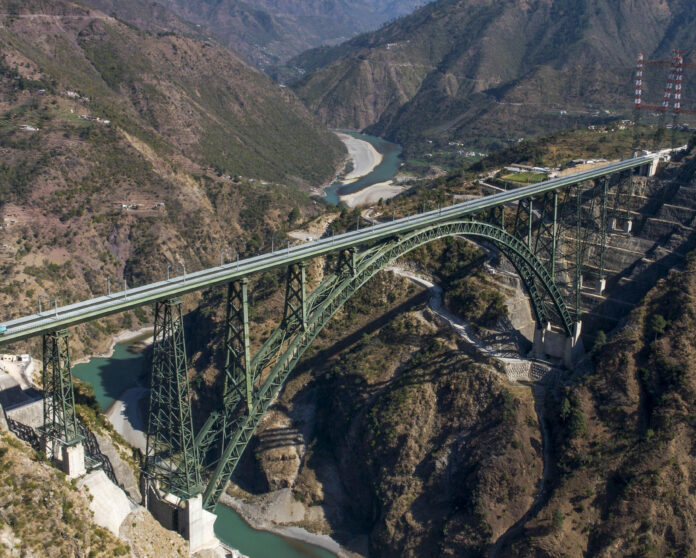
Jammu & Kashmir: Once facing the possibility of abandonment amid legal and environmental hurdles, the world’s highest railway bridge over the Chenab river has emerged as one of India’s most iconic engineering achievements. The historic Chenab Rail Bridge was formally inaugurated as part of the Katra–Srinagar railway section when Prime Minister Narendra Modi flagged off the Vande Bharat Express between Katra and Srinagar on June 6, 2025.
Towering 359 metres above the riverbed — 35 metres higher than the Eiffel Tower — the 1,315-metre-long steel arch bridge is a central component of the 272-km Udhampur-Srinagar-Baramulla Rail Link (USBRL), aimed at integrating the Kashmir Valley with India’s broader railway network.
A Project Once on the Brink
The bridge’s journey was far from smooth. Around 2008, amid legal challenges and environmental concerns that escalated to the Supreme Court of India, the project was suspended for over 90 days. The Railway Board reportedly explored alternatives, including replacing the arch bridge with a tunnel.
At that critical juncture, the Board informed Afcons Infrastructure Limited that it could exit the contract if it chose to do so. The company, however, decided to stay despite mounting financial risks.
Executive Chairman Krishnamurthy Subramanian recalled deliberations with then chairman Cyrus Mistry, who later died in a road accident in 2022. “If we walked away, there would be difficulties in completing it. We took the risk to stay put and finish the job,” Subramanian said, describing the project as one of international significance.
Engineering Against the Odds
The original plan always envisaged an arch bridge, but environmental litigation temporarily halted progress before the Supreme Court restored the original alignment. Over time, additional technical requirements — including blast load considerations — were introduced, requiring design adjustments as construction advanced.
Subramanian noted that no bridge of this magnitude had previously been built in India. “Where everybody thought it was not doable, if we could show that it can be done, the company could establish itself as a pioneer in engineering,” he said.
Completed after more than two decades from contract signing in 2004 to inauguration in 2025, the Chenab Arch Bridge now stands as a testament to persistence, innovation and complex project execution under extreme geological and climatic conditions.
Beyond Chenab
Afcons has also delivered other landmark infrastructure projects, including India’s first underwater metro tunnel beneath the Hooghly River in Kolkata. The company is currently engaged in constructing an undersea tunnel in Thane, Maharashtra, for the Mumbai–Ahmedabad bullet train corridor.
With the operationalisation of the Chenab Bridge and the Katra–Srinagar section, the USBRL project has achieved a milestone long envisioned — physically linking Kashmir to the rest of the country by rail and showcasing India’s growing engineering capabilities on the global stage.