

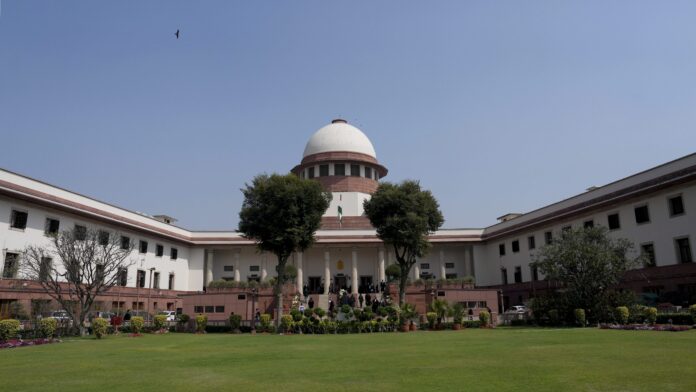
Flagging “uneven” compliance with Solid Waste Management (SWM) norms across the country, the Supreme Court of India has said the present generation cannot afford to wait for further legislative refinement while gaps in implementation persist.
Observing that the right to a clean and healthy environment is an “inseparable part” of the right to life under Article 21 of the Constitution, a bench of Justices Pankaj Mithal and S V N Bhatti issued a slew of pan-India directions to ensure effective enforcement of the Solid Waste Management Rules, 2026, which will come into force from April 1.
In its February 19 order, the bench noted that compliance with municipal solid waste (MSW) and SWM Rules remains inconsistent across India. “While mandated at source, segregation into wet, dry and hazardous streams is still not fully realised in many urban and rural areas,” the court said.
The bench pointed out that massive dumpsites continue to operate in several metropolitan areas, despite bio-remediation efforts under existing mandates. It warned that neglecting municipal solid waste would impact public health as much as the economy, especially as India positions itself as a global player in technology-driven growth.
“It is now or never. Expecting high results without fundamental spadework of source segregation and infrastructure would be unreasonable. Every stakeholder is duty-bound to ensure the realisation of a waste-free India,” the court observed.
The order came while hearing two appeals arising out of separate directions issued by the National Green Tribunal concerning environmental compliance by the Bhopal Municipal Corporation under the Solid Waste Management Rules, 2016.
Key Directions Issued
The court designated councillors, mayors, chairpersons, corporators and ward members as “lead facilitators” for source-segregation education, making it their statutory duty to ensure citizen enrolment in implementing the 2026 Rules within their respective wards.
District collectors have been empowered to conduct infrastructure audits of solid waste management systems and oversee waste handling by municipal corporations, municipalities and gram panchayats. They must communicate identified gaps and corrective measures to the chief secretary in a time-bound manner.
Local bodies have been directed to:
- Establish and publicise a clear outer time-limit for achieving 100% compliance.
- Email photographic evidence along with compliance reports to district collectors to verify on-ground progress.
- Immediately inform all bulk-waste generators about the 2026 Rules and the apex court’s order, ensuring full statutory compliance by March 31.
- Launch public-awareness campaigns to educate citizens on waste minimisation, home composting, proper wrapping of sanitary waste and mandatory segregation.
Pollution control boards have been instructed to identify and expedite infrastructure for four-stream segregation—wet, dry, sanitary and special care waste.
Enforcement and Penalties
The court made it clear that non-compliance will no longer be treated as a mere administrative lapse. It outlined a three-tier enforcement framework, beginning with immediate fines for initial violations by waste generators or local authorities.
Continued non-compliance may attract criminal prosecution under environmental laws, extending to individuals responsible for contributing to or abetting violations, including officials who fail in their oversight duties. The court also noted that deployment of mobile courts is under consideration to address real-time violations.
Awareness and Education Measures
To bridge awareness gaps, the court directed that summaries of the Solid Waste Management Rules, 2026—particularly provisions concerning households—be translated into local languages of respective states and Union Territories.
It also asked the Ministry of Environment, Forest and Climate Change to issue directions under Rule 33 to incorporate solid waste management practices into school curricula.
The bench clarified that these directions are part of preparatory measures ahead of the April 1, 2026 effective date. It further requested chief justices of high courts and chairpersons of tribunals to ensure compliance with the 2026 Rules by all courts and tribunals within their jurisdictions from that date.
Reiterating the State’s constitutional duty to safeguard the environment, the court underlined that ensuring a waste-free India requires coordinated action from governments, institutions and citizens alike.