

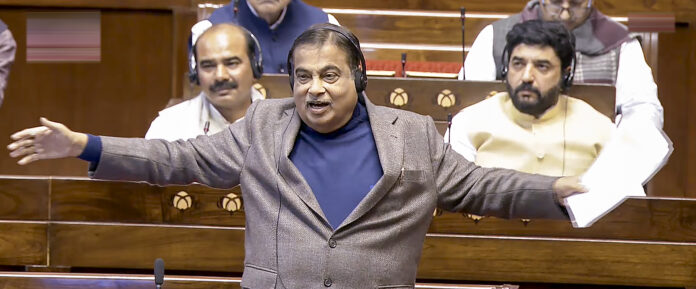
Union Minister for Road Transport and Highways Nitin Gadkari announced on Wednesday that India will implement the Multi-Lane Free Flow (MLFF) toll system and AI-driven highway management technology by the end of 2026. This initiative aims to transform the toll experience for commuters, effectively eliminating waiting times at toll plazas across the nation.
During the Question Hour in the Rajya Sabha, Gadkari explained that the MLFF system employs cutting-edge artificial intelligence, satellite technology, and number plate recognition. This innovation will enable vehicles to traverse toll points at speeds of up to 80 km per hour without stopping.
“With the MLFF system, commuters will no longer need to halt at toll plazas,” Gadkari asserted, noting that this new mechanism will replace the existing FASTag system. He highlighted that toll payments previously required three to ten minutes, which the FASTag system has reduced to under a minute. “We aim to bring waiting time down to zero minutes,” he stated.
The Minister further elaborated on the benefits of MLFF, revealing that it would save fuel costs estimated at ₹1,500 crore and increase government revenue by an additional ₹6,000 crore. Moreover, the implementation of this system is expected to eradicate toll leakage and theft completely.
“We anticipate completing this project fully by 2026. Once operational, the MLFF system will not only enhance transparency but also ensure commuters face no inconvenience at toll plazas,” Gadkari assured the House.
Gadkari also mentioned that the AI-enabled technology would significantly cut down travel time and improve the overall efficiency of national highways across India. This development marks a crucial leap toward modernising the country’s highway infrastructure.
Clarifying the central government’s responsibilities, the Minister stated that they are accountable only for national highways, which often gets misconstrued with issues related to state highways or city roads. These misunderstandings are frequently propagated on social media platforms.
“We are committed to creating a transparent, efficient, and corruption-free system that benefits all road users,” Gadkari said, reinforcing the government’s dedication to enhancing road travel.
This announcement not only signifies a substantial improvement in toll collection mechanisms but also reflects a broader commitment to revamping India’s road infrastructure. The forthcoming changes promise a more seamless and efficient travel experience for millions of motorists across the nation.