

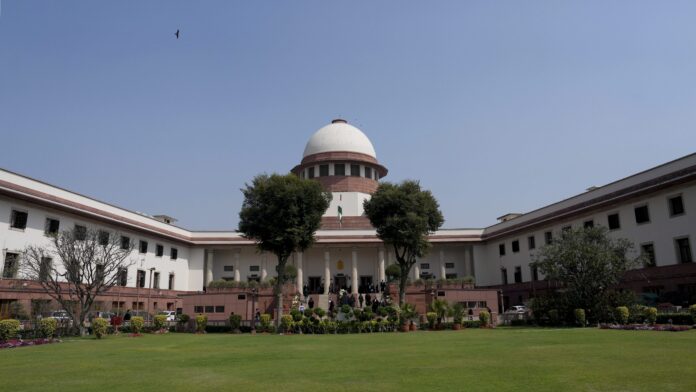
The Supreme Court has raised alarms over a concerning trend where judges issue a flurry of orders just before retirement. CJI Justice Surya Kant described this behavior as akin to a batter ‘hitting sixes in the final overs’ during a cricket match.
This observation surfaced as the Bench, comprising Justices Joymalya Bagchi and Vipul M. Pancholi, heard a petition from a Principal District and Sessions Judge of Madhya Pradesh. The petitioner contested his suspension, imposed just ten days prior to his retirement.
During the proceedings, the Chief Justice remarked, “It is an unfortunate trend. There is a growing tendency of judges passing so many orders just before retirement.” He noted that the judicial officer had begun to “hit sixes” shortly before his retirement.
The judge was set to retire on November 30 but faced suspension on November 19, based on decisions made during a recent Full Court session of the Madhya Pradesh High Court. This suspension followed two judicial orders issued shortly before his retirement.
Senior advocate Vipin Sanghi, representing the petitioner, highlighted the officer’s impeccable service record, underscoring his consistently high ratings in Annual Confidential Reports (ACRs). Sanghi argued that disciplinary actions against judicial officers shouldn’t arise solely from their judicial decisions.
“How can an officer be suspended for judicial orders that are appealable and can be reviewed by higher courts?” Sanghi questioned emphatically.
The Supreme Court acknowledged the issue at hand, emphasizing that disciplinary proceedings typically do not arise from judicial errors. CJI Kant, however, posed a critical question, “What if the orders are palpably dishonest?” This distinction underscored the difference between genuine judicial error and misconduct.
Interestingly, the Supreme Court announced that on November 20, it directed the Madhya Pradesh Government to increase the retirement age of judicial officers from 60 to 61 years. This alteration means that the petitioner’s revised retirement date is now November 30, 2026. The CJI pointed out that the officer was unaware of this extension when he made the contested decisions.
The Bench also examined why the judicial officer had not sought to challenge the suspension through the High Court. Sanghi responded that the petitioner believed a direct appeal to the Supreme Court was warranted, given that the suspension stemmed from a Full Court ruling.
The Supreme Court noted that past decisions showed that Full Court rulings could indeed be overturned in judicial reviews.
Moreover, the Court criticized the officer’s pursuit of information about his suspension through applications filed under the Right to Information (RTI) Act. “It is not expected of a senior judicial officer to resort to the RTI route. He could have submitted a representation,” the Bench remarked, emphasizing proper protocol.
In a decisive move, the Supreme Court declined to entertain the petition at this stage. However, it allowed the judicial officer to submit a representation before the Madhya Pradesh High Court to seek a recall of the suspension order. The Bench instructed the High Court to consider and address this representation within a span of four weeks.